
Carrier VRF Static Pressure

All ducted VRF systems come from the factory set for 0” of static pressure. As we know from experience, this is not possible when any ductwork is attached. 0” of static pressure is only in a factory setting with nothing attached.

You may be asking yourself “What happens if Static isn’t updated?” When static pressure isn’t set on a ducted indoor unit, this makes the algorithm always operate the fan in the lowest fan speed possible. As you can imagine, this won’t work.
So how do we set Static Pressure? This can be achieved on both WIRED remote controls. The programmable controller is not only an easy-to-use thermostat, but also a great service tool as well.

Let’s start with the programmable control first:
40VM900003 programmable (Carrier)
40VM900013 programmable (Bryant)

We need to get into the Service Menu by Holding “FAN” and “BACK” for roughly 3-5 seconds.

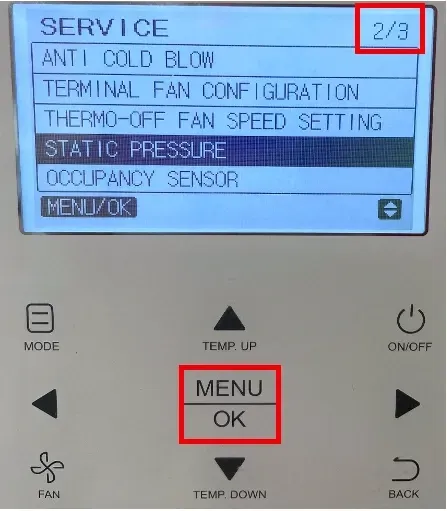
Once inside the service menu scroll down to Page 2 of 3 indicated by the top right corner of the screen. Highlight “Static Pressure” and hit “Menu/Ok”.

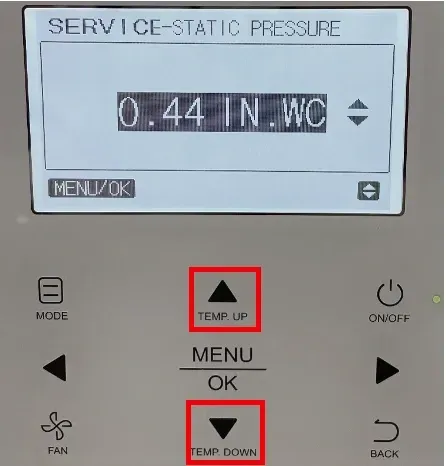
In the menu use the Up/Down arrows to choose static pressure setting and press Menu/OK to confirm.

Now on to the non-programmable model.

40VM900002 non – programmable (Carrier)

40VM900012 non – programmable (Bryant)

This model uses a different method to make any advanced settings. First, press any button to wake the controller up and light the screen then press and HOLD “MODE” and “FAN” for 5 seconds to access the Service Menu. You’ll know you’re successful when the display changes to 0 0.

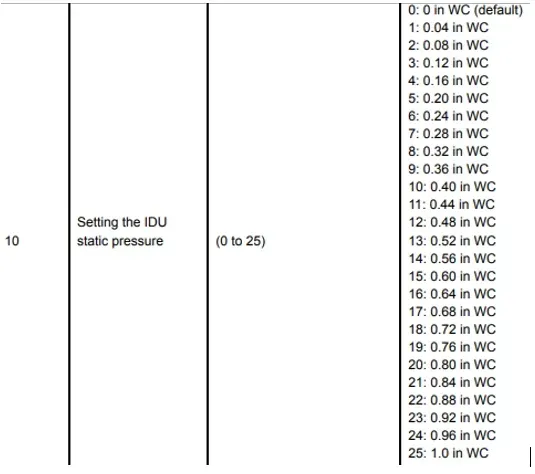
The code on the left is known as “1G” and the right as “2G”. Pressing the up and down arrow scrolls through the various 1G codes. Static Pressure is #10 for 1G. Press “OK” to move to the 2nd code. Use the chart below to determine what 2G code should be used then press ok to confirm.

To exit back to home screen either wait 30 seconds or press back twice. This applies to both controllers.

Now that static pressure is set in the thermostats you should hear the fans ramp to their appropriate speeds.

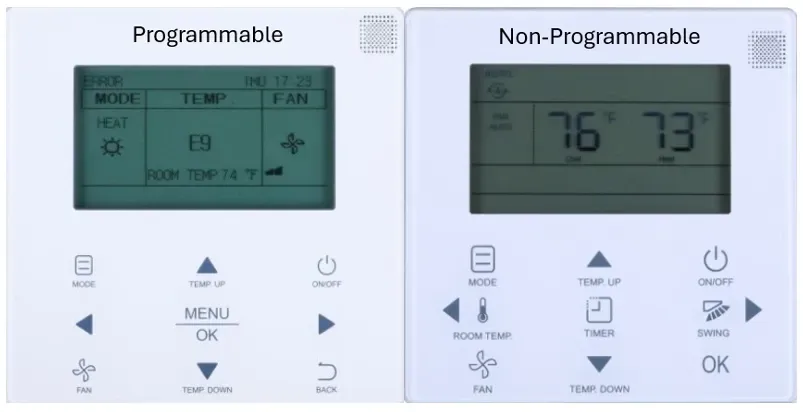
If you are ever in doubt about which thermostat you are working with, below is a side-by-side picture to help you figure it out.

Disclaimer: The technical statements, information and recommendations contained herein are believed to be accurate as of the date hereof, but Mingledorff’s does not make representations or warranties, express or implied, as to its accuracy, its completeness, or the results to be obtained. The information is being provided for informational purposes only and is intended for use by persons having adequate skill and expertise regarding the proper selection, use and application of the products and recommendations and at their own risk and discretion. 

More to explore

ICP Furnace Showing 80% Limit Fault

Most gas furnaces have several safety limits, main limits, roll-outs, 80%’s will have a DSS (Daft Safety Switch) These safety

Indoor TXV Failure in Heat Mode

This article is in reference to Residential Heat Pumps.                 Everyone in the HVAC industry knows that the indoor TXV

Compressors Problems & Troubleshooting

Compressors are the heart of the refrigeration system. It creates the pressure difference to move the refrigerant through the system.