Schematic examples of the Safety Chain for RTU’s – Part 1
Tip: click the images to open an enlarged view in another tab. Close the tab to return to the article.


This article is in reference to Residential Heat Pumps.
Everyone in the HVAC industry knows that the indoor TXV does not do anything in the heat mode, right? -or does it do something? Let us discuss it!
In the Heat Mode, the reversing valve reverses the refrigerant flow through the system. Now, the indoor coil is the condenser, and the outdoor coil is the Evaporator. This means the outdoor coil is COLD due to a metering device like a piston or TXV, and the indoor coil is going to be HOT. Since the refrigerant is flowing backwards it comes right out the discharge of the compressor and goes to the indoor coil with HOT gas. This gas passes through the indoor coil nonstop without using a piston nor TXV and gives up heat to the air in the home; when heat is removed from this gas, it turns into a warm liquid.
In the description laid out in the paragraph above, you see that the indoor TXV has no job in the Heat Mode, so you think. It does have a job though; its job is to “bypass.” There is a bypassing check valve built into Heat Pump TXV’s. If this bypassing check valve fails, then the TXV cannot do its “bypassing” job.
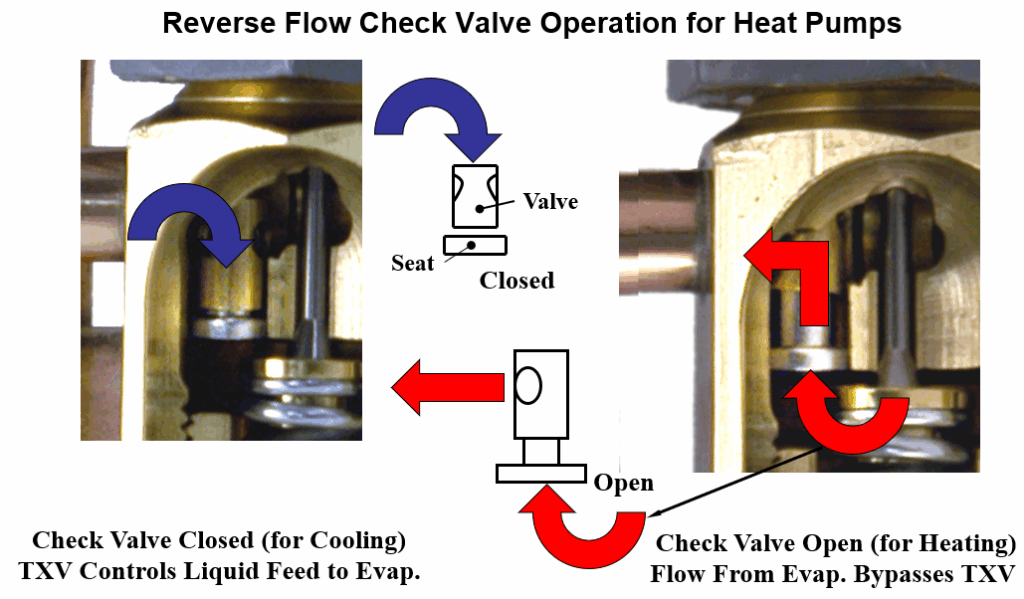
What would this failure look like, or how would this look like on a system?
If this bypassing check valve fails, then the refrigerant will slow down/ or stop in the indoor coil. Diagnosing this uses the liquid line pressure.
Typically, there are two ways the bypassing check valve fails in Heat Mode:
So, what SHOULD your liquid line pressures be in heat mode?
The liquid line pressures in heat mode should favor or be near (ish) the head pressure. As you know, the head pressure is variable depending on indoor and outdoor temperatures. Unfortunately, there is no statistical data provided by any manufacturer for what the liquid line pressures should be in heat mode. However, we do know what they should not be. They should not be pulling down and looking like suction pressures nor anywhere close to those pressures. The liquid line TEMPURATURE should not be colder than the indoor dry bulb temperature of the home.
Remember, if the bypassing check valve in the TXV is doing its job, it should freely flow refrigerant right through the valve with no temperature drop across it.
Disclaimer: The technical statements, information and recommendations contained herein are believed to be accurate as of the date hereof, but Mingledorff’s does not make representations or warranties, express or implied, as to its accuracy, its completeness, or the results to be obtained. The information is being provided for informational purposes only and is intended for use by persons having adequate skill and expertise regarding the proper selection, use and application of the products and recommendations and at their own risk and discretion.
Tip: click the images to open an enlarged view in another tab. Close the tab to return to the article.
Carbon Monoxide is a colorless, odorless, tasteless gas that can be extremely dangerous and even deadly. Because you cannot see
Have you ever had a fault code 44 on a FE4 or FE5 infinity or evolution fan coil? Do you
We use cookies and other tracking technologies to collect and store information, operate our website, remember your preferences, deliver targeted ads and content, and enhance your experience. You can manage or change your cookie preferences at any time through your browser or device settings. To learn more, including how we collect, use, or disclose your information, please review our Privacy Policy and Terms of Use. By interacting with this cookie banner or accessing the site, you consent to our Privacy Policy and Terms of Use, including the arbitration provision and class action waiver.