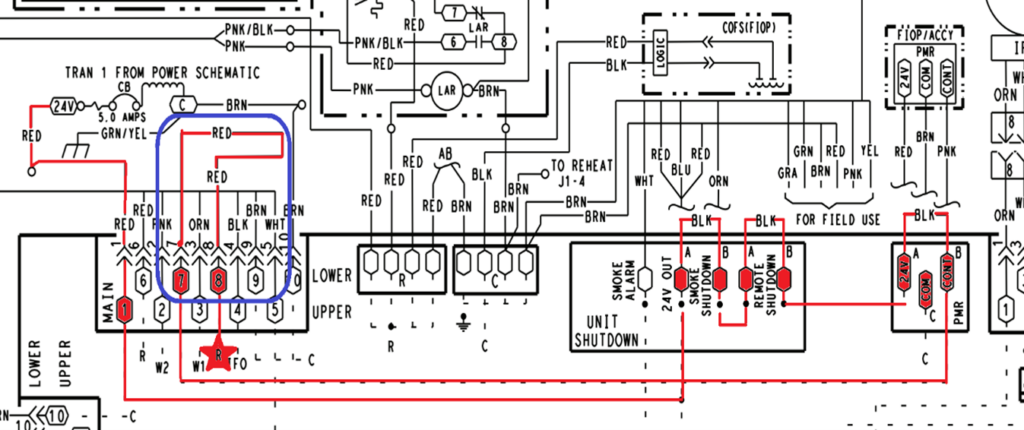

Schematic examples of the Safety Chain for RTU’s – Part 1

Tip: click the images to open an enlarged view in another tab. Close the tab to return to the article. 

In this series of Tech-Tips articles, we will be going over some of the wiring diagrams and their paths for simplifying troubleshooting.

Examples in this series will be: R, G, Y1, Y2, W1, W2 through various boards as well as types of fans being used like Direct Drive, VFD or Ecoblue, as well the (RDB) Refrigerant Dissipation Board.

Each measurement will be taken from the testing point to ground after verifying you have voltage to common. Then, you move on to the next test point and verify each one until you find where you are losing your voltage.

The 1st example is a UCB board which has a looper wire on pins 7 and 8.

Example 1: 48FC 04-07 RED LOOPER WIRE

Details for Example 1:

  • 24vac from transformer
  • UCB Main Pin 1
  • Smoke Shutdown A
  • Smoke Shutdown B
  • Remote Shutdown A
  • Remote Shutdown B
  • Phase Monitor (PMR)
  • A(24v)
  • PMR B(CONT)
  • Main Pin 7
  • Just a RED wire in a loop from Pin 7-8
  • Main Pin 8
  • R

You now have “R!”

Remember to check all voltages to ground.

Example: 24VAC to ground at Pin 1 on UCB Main, then Smoke Shutdown A to ground etc, etc…  If you have voltages all the way to Pin 8 on UCB Main then you will have Voltage on R terminal.

The 2nd example has a (LSM) Limit Switch Manual in it. Both are the R circuit. The next few Tech-Tips will have various wiring diagrams with different locations on Pins 7 and 8 as well as other paths we will cover individually.

Example 2: Ecoblue with LSM
  • 24vac from transformer
  • UCB Main Pin 1
  • Smoke Shutdown A
  • Smoke Shutdown B
  • Remote Shutdown A
  • Remote Shutdown B
  • Phase Monitor (PMR) A(24v)
  • PMR B(CONT)
  • Main Pin 7
  • LSM Input
  • LSM Output
  • Main Pin 8
  • R

You now have “R!” 

Disclaimer: The technical statements, information and recommendations contained herein are believed to be accurate as of the date hereof, but Mingledorff’s does not make representations or warranties, express or implied, as to its accuracy, its completeness, or the results to be obtained. The information is being provided for informational purposes only and is intended for use by persons having adequate skill and expertise regarding the proper selection, use and application of the products and recommendations and at their own risk and discretion. 

More to explore

The Danger of Carbon Monoxide

Carbon Monoxide is a colorless, odorless, tasteless gas that can be extremely dangerous and even deadly. Because you cannot see