Taking NATE Online
We have recently begun teaching our NATE classes online using zoom format. This article will hopefully clear up some of


Carrier has approved the use of Crossover equipment with zoning applications. The instructions for this will be released in several phases during 2026. Release dates for the different phases of instructions are subject to change.
First phase:
Second phase:
Third phase:
*See product bulletin 101-26-13 (Carrier) or BY-103-26-13 (Bryant) for complete instructions.
Important things to consider for zoning when using Crossover equipment:
1. Static pressure. The blowers provide a constant air volume based on the mode of operation. The 45MUAA fan coils can handle up to .8” static, above which CFM performance falls off dramatically. The 45MUHA 18-36K are rated up to 1” static. 45MUHA 48-60K are rated at .8”.
2. Bypass. Because of the constant air volume motor, the blower is likely to hunt if static pressure changes significantly while running. It is also necessary to use the dump zone method vs bypassing supply air directly into the return. When using the standard supply-to-return bypass method, the T1 (return air) thermistor will be deceived any time the bypass damper opens due to direct supply air on the sensor. See below for an example of a dump zone design.
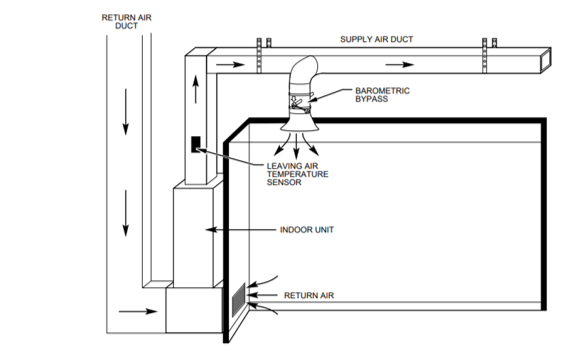
3. The Algorithm. Capacity request (CR) and target evaporator setpoint (TES) are at the core of logic driving the inverter frequency. This is a very important difference from a standard or Infinity/Evolution zone system. CR is calculated from indoor temperature vs setpoint. TES is based on mode of operation (heat or cool) and Y1 vs Y2 demand. But how does the logic determine what these temps are?
Be aware Carrier has not validated any third-party zoning for use with the Crossover equipment. The instructions will be revised and re-issued at times. Always refer to the most up-to-date literature which can be found on HVACPartners.
Addendum (6/23/26):
Carrier’s compliance with CVP (Control Verification Procedure) requires that the Crossover outdoor units be wired for communication only. It will be necessary to add a 24-volt interface (KSAIC0701230) with any non-communicating indoor unit, and that when a Crossover fan coil is used, it must be wired for communication.
*The built-in interface on the Crossover outdoor unit will remain for emergency use only.
References:
• Product Bulletin: 101-26-13
• Product Bulletin: BY-103-26-13
• CA-Crossover-Zoning
• BR-Crossover-Zoning
• 37MURA-02SI.pdf
• 37MUHA-02SI.pdf
• 45MUAA-02SI.fm
• 45MUHA-03SI.fm
• ZONE4CN-02SISP.pdf
Disclaimer: The technical statements, information and recommendations contained herein are believed to be accurate as of the date hereof, but Mingledorff’s does not make representations or warranties, express or implied, as to its accuracy, its completeness, or the results to be obtained. The information is being provided for informational purposes only and is intended for use by persons having adequate skill and expertise regarding the proper selection, use and application of the products and recommendations and at their own risk and discretion.
We have recently begun teaching our NATE classes online using zoom format. This article will hopefully clear up some of
Coming back to work after an extended weekend of 4th of July there’s paperwork handed to you for the emergency
Tip: click the images to open an enlarged view in another tab. Close the tab to return to the article.
We use cookies and other tracking technologies to collect and store information, operate our website, remember your preferences, deliver targeted ads and content, and enhance your experience. You can manage or change your cookie preferences at any time through your browser or device settings. To learn more, including how we collect, use, or disclose your information, please review our Privacy Policy and Terms of Use. By interacting with this cookie banner or accessing the site, you consent to our Privacy Policy and Terms of Use, including the arbitration provision and class action waiver.
You are leaving our site and we cannot be held responsible for the content of external websites.