
September 16, 2026
CARRIER 1PH VRF: Mystery of the P## Errors
Many things have changed in recent years. A new refrigerant, the next generation of Carrier VRF & Ductless products, and technician overall lack of good understanding of some product operations. Let us be honest, most service documentation is lacking when explaining to technicians what an error is and how to solve the problem. Today we will cover a recent issue that goes mostly undocumented within service manuals as to what the true solution is.
With the most recent single phase Carrier VRF system there was a whole new process in installing, troubleshooting, and how to properly verify system operations. If you have ever come upon the P23 and/or P11 error codes during an install hopefully this article will shed some light on what to look for. But first we need to know what these errors are.
P11 – HIGH PRESSURE SENSOR FAULT
P21 – LOW PRESSURE SENSOR ERROR
P23 – SUCTION PIPE LOW PRESSURE PROTECTION
These would appear to be the simplest of error codes, right? Well, you may be right……. Maybe not.
Solution 1: CHECK YOUR VALVES
If the compressor has ever run, this may be due to a closed main valve, or worse yet, truly low charge if you put the appropriate amount of charge in it.
Solution 2: CHECK YOUR ELECTRICAL CONNECTIONS
Something that has always been best practice is making sure the electrical connections are all tight. This includes factory installed connections, these units are put together by human beings and to er is human.
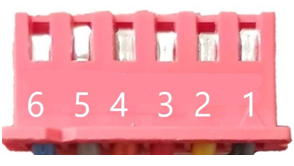
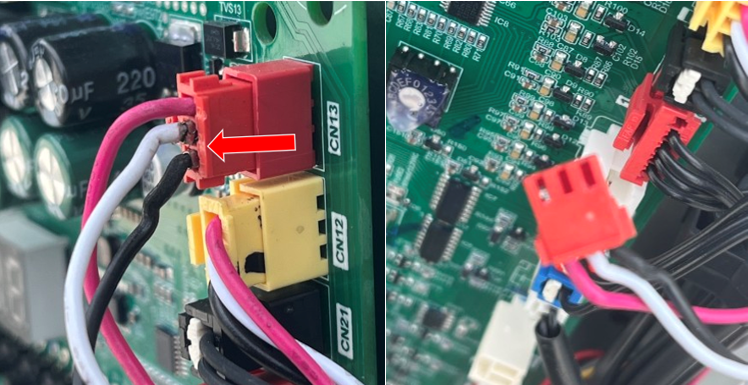
Pictures below show a system that was intermittently giving P11 error codes on startup. After cutting back some securing zip ties, we found that the white and black wires were not fully in the plug’s well and had, more than likely, pulled out during the process of securing wires at the factory. This can be verified by the missing connection points on one side of the connector.
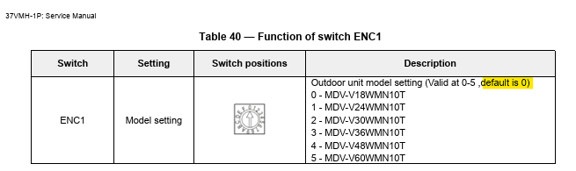
Solution 3: CHECK ROTARY DIAL SETTINGS
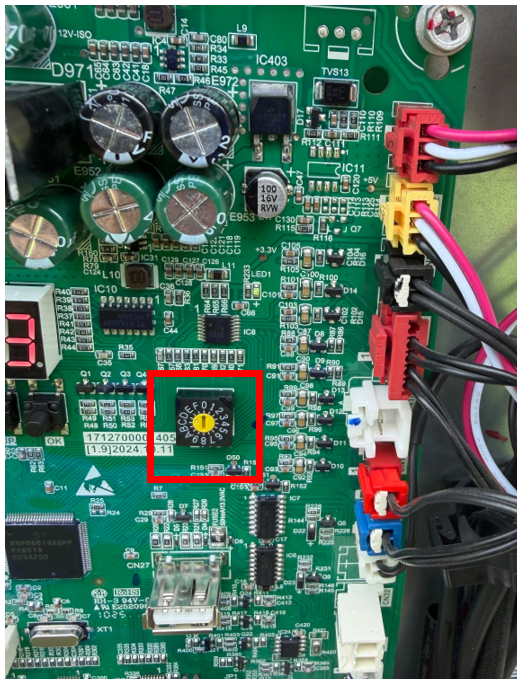
The last scenario on our list is after a main board change. When new boards come from the factory they come with no settings in the memory and need to be told what unit they are being installed in. The boards are dummy boards and can be put into many different units varying in capacity. It is always a great idea to take a picture of dipswitches, rotary dials, and wiring connections to reference during the install and setup of a new board. Make sure to follow any instructions that come with a new board. The service manual from HVACPartners can also be used to determine what settings need to be set during a board change.


The board above was a new board installed in a 60k ODU and was set to think it was a 18K due to the setting of the ENC1 Rotary Dial on the board. The system was looking for certain pressures and line temperatures for the 18K ODU algorithm. There are sensors that exist on the larger ODU that do not exist on the smaller units. Check the service manual for more details. These being set incorrectly can lead to less than satisfactory operation (or in this case, lack thereof). Verifying that all dipswitches and rotatory dials are a very important part of board replacements and careful attention needs to be paid to save time, aggravation, and costs of revisiting a jobsite until the issue is resolved on a newer system. Do yourself a huge favor and read before making any changes.
This concludes this month’s article referring to recent Carrier 1PH VRF errors and their solutions. Join us next month to continue down the rabbit hole with a whole new set of errors, their solutions, or best practice.
Disclaimer: The technical statements, information and recommendations contained herein are believed to be accurate as of the date hereof, but Mingledorff’s does not make representations or warranties, express or implied, as to its accuracy, its completeness, or the results to be obtained. The information is being provided for informational purposes only and is intended for use by persons having adequate skill and expertise regarding the proper selection, use and application of the products and recommendations and at their own risk and discretion.
More to Explore