Taking NATE Online
We have recently begun teaching our NATE classes online using zoom format. This article will hopefully clear up some of


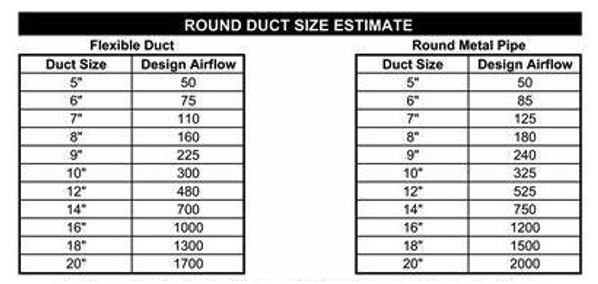
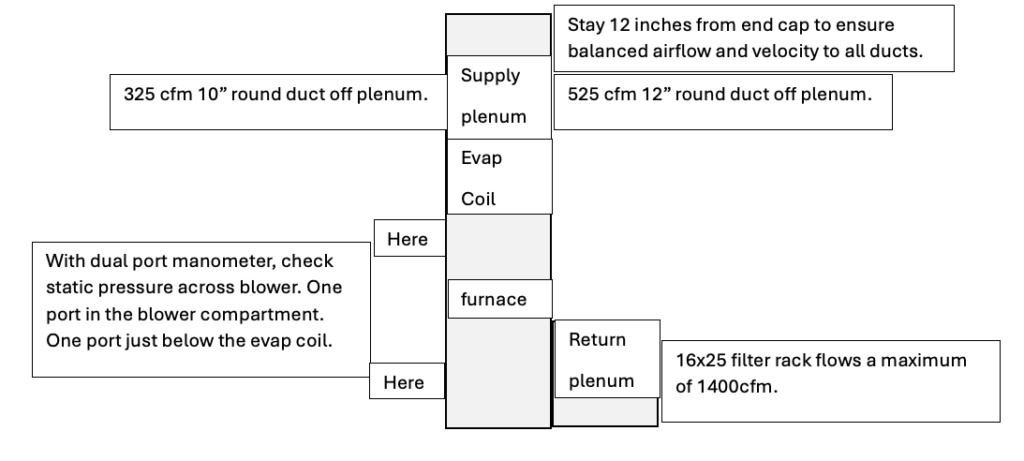
What all goes into “duct design”? Most important is having a balanced system, meaning what comes in (return) must go out (supply). An old school way of thinking is 400 CFM per ton. Several years back, Carrier started designing their CFM charts for 350 CFM per ton, and moving forward, that is how we should also look at our systems that we are replacing or redesigning. Included in the article is an example of a 2.5-ton system and some best practices on sizing. There is also a chart that lists how much CFM a certain-sized duct will flow. Please take careful note of all the text in the example system, as there are a lot of best practices listed there.
I took from a common 3-ton furnace installation manual the CFM Blower chart. Checking for static pressure and changing your speed taps on your blower is vital to flowing the proper CFM per ton and helping the longevity of both the indoor blower motor and outdoor compressor. Prior to 2023, unit rating tests for SEER1 were performed at 0.2” static. Then starting in 2023 Jan 1st the SEER2 is now tested at 0.5” static. In a real-world scenario, this is hard to recreate. This is another reason why checking static and blower speed is very important. You can still achieve 350 CFM per ton if your static is above 0.5 by changing blower speeds, but most importantly, perhaps, is the duct sizing.
Some key things to realize as well are your filter pleating. When it comes to a standard 1” filter, most people think that an expensive allergy-rated filter is better for you, but in all actuality, it is hurting the airflow of your system and causing strain on key mechanical components. A middle-of-the-road 1” filter is all you need for proper airflow. Media type filters are a little different, as they allow better filtration and better airflow. Another thing to note is proper filter sizing.
• A 16×25 opening only allows for a maximum of 1400 CFM. That’s about a 3.5-ton max.
• 20×25 openings allow for approximately 1600 CFM, which would be a 4-ton max.
• Lastly, if you have a 5-ton unit, it is critical to have dual returns to bring in the proper amount of return air
If you have any questions about the airflow charts in the residential furnace manuals please direct them to 770-239-2130.
Default Carrier setting 350cfm per ton

See below for a typical example of a 2.5 ton unit.
875cfm at .5 static.
Cfm chart above is for a standard comfort series 17 wide 3 ton furnace.
STATIC PRESSURE MATTERS!!! Duct design matters for proper operation of equipment.
Return and supply must be balanced. 1050cfm for both.
Disclaimer: The technical statements, information and recommendations contained herein are believed to be accurate as of the date hereof, but Mingledorff’s does not make representations or warranties, express or implied, as to its accuracy, its completeness, or the results to be obtained. The information is being provided for informational purposes only and is intended for use by persons having adequate skill and expertise regarding the proper selection, use and application of the products and recommendations and at their own risk and discretion.
We have recently begun teaching our NATE classes online using zoom format. This article will hopefully clear up some of
Coming back to work after an extended weekend of 4th of July there’s paperwork handed to you for the emergency
Carrier has approved the use of Crossover equipment with zoning applications. The instructions for this will be released in several phases during 2026. Release dates for
We use cookies and other tracking technologies to collect and store information, operate our website, remember your preferences, deliver targeted ads and content, and enhance your experience. You can manage or change your cookie preferences at any time through your browser or device settings. To learn more, including how we collect, use, or disclose your information, please review our Privacy Policy and Terms of Use. By interacting with this cookie banner or accessing the site, you consent to our Privacy Policy and Terms of Use, including the arbitration provision and class action waiver.
You are leaving our site and we cannot be held responsible for the content of external websites.