Taking NATE Online
We have recently begun teaching our NATE classes online using zoom format. This article will hopefully clear up some of


This month I will be covering how to troubleshoot a PMW Blower Motor on a Carrier furnace.
What is a PWM motor? The acronym PWM stands for Pulse Width Modulation. For motor controllers, PWM can refer to both the input signal and the method the controller uses to control motor speed.
The blower motor has 115 VAC applied to it anytime the furnace is powered, so you will need to verify this. Manually close the blower door switch and measure the voltage between L1 and Neutral L2 wires as shown below on the control board. (Note; If 115 VAC is not present, check incoming power to furnace.)
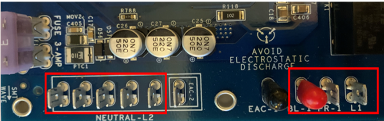
Open the blower door switch, disconnect black lead between power choke and motor. On ¾ & 1 PWM horsepower motors will have a power choke located on the blower housing. Power chokes are used to filter line power and to reduce current draw of the motor. The power choke may be bypassed for troubleshooting purposes. Insert your meter lead into disconnected power lead and manually close the blower door switch. Verify 115 VAC is present. If correct voltage present, open blower switch and reconnect power leads.
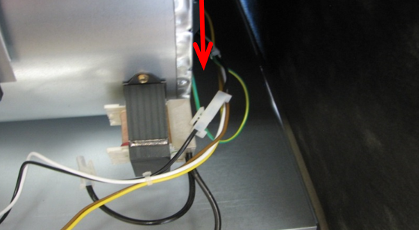
Checking for secondary voltage, the PWM blower motor used in the current furnaces is controlled by ON/OFF switching of the DC voltage circuit through the motor controller (CPU).
Manually close the blower door switch and verify 24 VAC between R and C at the thermostat terminals on the furnace control board as shown below.
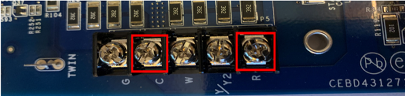
There are only two wires to control motor speed, brown wire feeds constant 15 VDC to the motor and yellow wire feeds back from the motor to the furnace control board.

Now you will need to check 15 VDC Power to Blower Motor. Verify all harnesses are connected and 115 VAC power is on. Close blower door switch. Set your meter to DC volts (VDC). Insert positive probe into the back of brown lead at PL16. Touch the other lead to C terminal on furnace control board. Voltage reading from the furnace control board should be about 15 VDC at the brown wire as shown below.
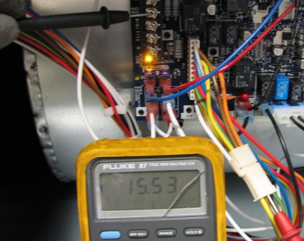
Note: a reading of approximately 35V (or higher) indicates the green ground wire on the motor is disconnected – repair as needed.
A 15 VDC reading is normal, may be slightly higher or lower as actual line volage affects low voltage. If measure voltage is unstable or scrolling, check harness connectors and pins.
Checking motor control signal, with no call for Fan from the thermostat, close the blower door switch. Your meter set to DC voltage (VDC), insert the positive lead into the back of the yellow lead of PL16. Touch the other lead to the C terminal on the furnace control board. With no motor operation, voltage will be 10 to 15 VDC as shown below.
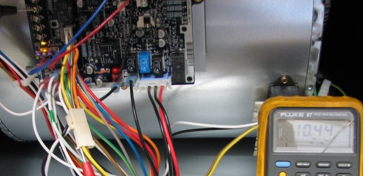
If voltage is 0 VDC or significantly below 10 VDC:
0 VDC indicates a likely “no connection” issue with the harness connector plugs at either PL13 (Motor) or PL16 (Harness)
Voltage significantly below 10 VDC indicates partial connection of harness connectors, or a damaged motor controller.
Checking the motor control signal, close the blower door switch and a call for Fan only from the Thermostat. Your meter set to DC voltage (VDC), insert the positive lead into the back of the yellow lead of PL16. Touch the other lead to the C terminal on the furnace control board. With the motor operating, voltage reading will 5 to 8 VDC as shown below.
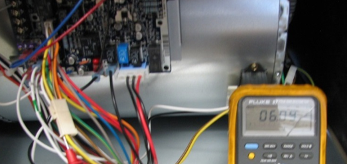
Remove the call for Fan, voltage reading will return to 10 to 15 VDC when the motor turns off.
Sources:
HVAC Partners, 59SC6A-01SI
Disclaimer: The technical statements, information and recommendations contained herein are believed to be accurate as of the date hereof, but Mingledorff’s does not make representations or warranties, express or implied, as to its accuracy, its completeness, or the results to be obtained. The information is being provided for informational purposes only and is intended for use by persons having adequate skill and expertise regarding the proper selection, use and application of the products and recommendations and at their own risk and discretion.
We have recently begun teaching our NATE classes online using zoom format. This article will hopefully clear up some of
Coming back to work after an extended weekend of 4th of July there’s paperwork handed to you for the emergency
Carrier has approved the use of Crossover equipment with zoning applications. The instructions for this will be released in several phases during 2026. Release dates for
We use cookies and other tracking technologies to collect and store information, operate our website, remember your preferences, deliver targeted ads and content, and enhance your experience. You can manage or change your cookie preferences at any time through your browser or device settings. To learn more, including how we collect, use, or disclose your information, please review our Privacy Policy and Terms of Use. By interacting with this cookie banner or accessing the site, you consent to our Privacy Policy and Terms of Use, including the arbitration provision and class action waiver.
You are leaving our site and we cannot be held responsible for the content of external websites.