Disclaimer: The technical statements, information and recommendations contained herein are believed to be accurate as of the date hereof, but Mingledorff’s does not make representations or warranties, express or implied, as to its accuracy, its completeness, or the results to be obtained. The information is being provided for informational purposes only and is intended for use by persons having adequate skill and expertise regarding the proper selection, use and application of the products and recommendations and at their own risk and discretion.
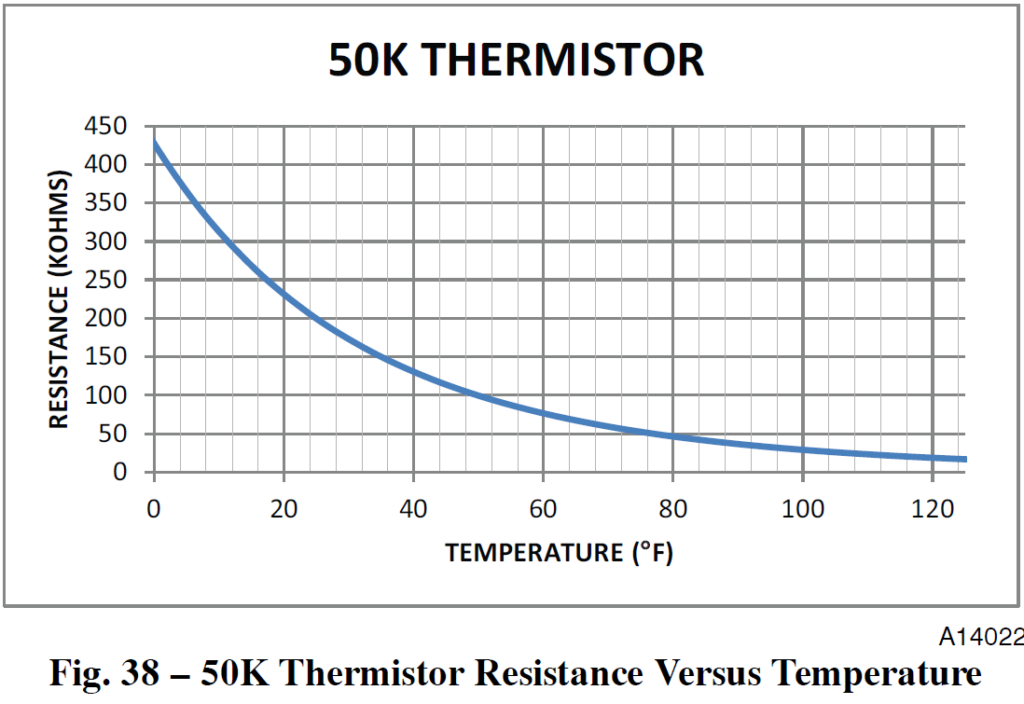

50K thermistor resistance-vs-temperature graph, blue curve on gray grid, resistance drops as temperature rises

Bubba Moore

Technical Services Manager Southeast District

August 12, 2021

Measuring Airflow Using Temperature Rise Method

What is airflow in a heating and cooling system? Why do we need to know what the airflow of a heating or cooling system is? Airflow is the amount of air measured in cubic feet per minute (CFM) that a system can deliver or move depending on its size. This CFM of a system is normally around 400 to 450 CFMs per ton of air. This can vary depending on the efficiency of the system. The reason we need to know the airflow of the system is to make sure that the system is performing as it was designed. Too much or too little airflow can affect comfort and cause equipment failures.


There are different methods of measuring airflow. The temperature rise method is fairly easy to use when measuring the CFMs on fan coils with electric heat. You will measure the amount of temperature rise across the electric heat elements, and also measure the voltage supplying the system, as well as the current flow or amps of the fan coil. The fan coil blower and electric elements will have to run continuously while preforming these measurements. Before taking any temperature readings or other measurements, make sure that the air filter is clean, and that all supply and return vents are opened and not blocked. Also, let the system run until the temperatures stabilize. Once the temperatures stabilize, measure the return air and supply air temperatures with an accurate electronic thermometer. Do not get your temperature reading above the electric elements. Make sure that these readings are down the duct or out of the line of sight of the electric elements.


After the measurements have been gathered, this data will be plugged into a formula to see what airflow (CFMs) the system is producing. The formula is: Airflow (CFM) equals volts times amps times 3.414 (BTUs per watt) divided by 1.08 times the temperature difference of the supply and return air.


Using 400 CFMs per ton, this airflow calculation would be close to 3 Tons of airflow.


This simple calculation could help prove whether or not the problem is related to airflow. There may be a collapsed duct, or insulation inside of the duct may have come loose. If there was an equipment failure, this CFM test could prove why the equipment failed. It could also prove that airflow was not the problem and help point to a different reason for the failure.


Sources: HVAC Services Procedures


More to Explore

September 16, 2026
Disclaimer: The technical statements, information and recommendations contained herein are believed to be accurate as of the date hereof, but Mingledorff’s does not make representations or warranties, express or implied, as to its accuracy, its completeness, or the results to be obtained. The information is being provided for informational purposes only and is intended for use by persons having adequate skill and expertise regarding the proper selection, use and application of the products and recommendations and at their own risk and discretion. 

By Jesse Van Atta • September 16, 2026
Disclaimer: The technical statements, information and recommendations contained herein are believed to be accurate as of the date hereof, but Mingledorff’s does not make representations or warranties, express or implied, as to its accuracy, its completeness, or the results to be obtained. The information is being provided for informational purposes only and is intended for use by persons having adequate skill and expertise regarding the proper selection, use and application of the products and recommendations and at their own risk and discretion.